
In his 2015 art installation, Jeff Koons placed blue gazing balls in front of 35 repainted and enlarged classic masterpieces like Da Vinci’s Mona Lisa or Titian’s Venus and Mars.
You have to give it to the man because not many people look at a classic and say to themselves, “You know what this is missing? BALLS!!!”
Of course, it is more than just balls. Koons explained that placing the gazing balls in front of the canvases brings the viewer into the painting, reflecting what our preconceptions do when we appreciate art, which alters our perception of art.
Koons — whose cool and composed demeanor seems more suited to a Zen Buddhist monk than to the acclaimed artist he is — points out that we can’t just shed our ideas, assumptions, and baggage. We always bring that with us wherever we go; Jon Kabat-Zinn says, “Wherever you go, there you are.”
Or in Koon’s case, “Wherever you go, you will bring your balls.” A proverb that applies to Koon as a man AND artist.
Let’s put the balls in a gusset for a moment. (If you don’t know what a gusset is, it is the small pocket in front of men’s underwear used to provide moisture-wicking. You might thinking, “Wow, I thought I was going to learn just about art-making but this is about much more.” And you are right. You are welcome.)
Back to the balls in the gusset.
Koons’ gazing material and his idea of how our identity shapes how we view and interpret art is an empowering belief for art appreciation and creation because it does not mention skills or critics’ appeasement.
At the core of it, it’s a truth about art, acceptance, and surrender.
We can only appreciate art from where we come from. We might empathize to understand how others would see it, or we could learn about history and art history to understand the conditions in which the art was born and why.
But what makes art personal is the individual, our individual experience, and our unique way of seeing it.
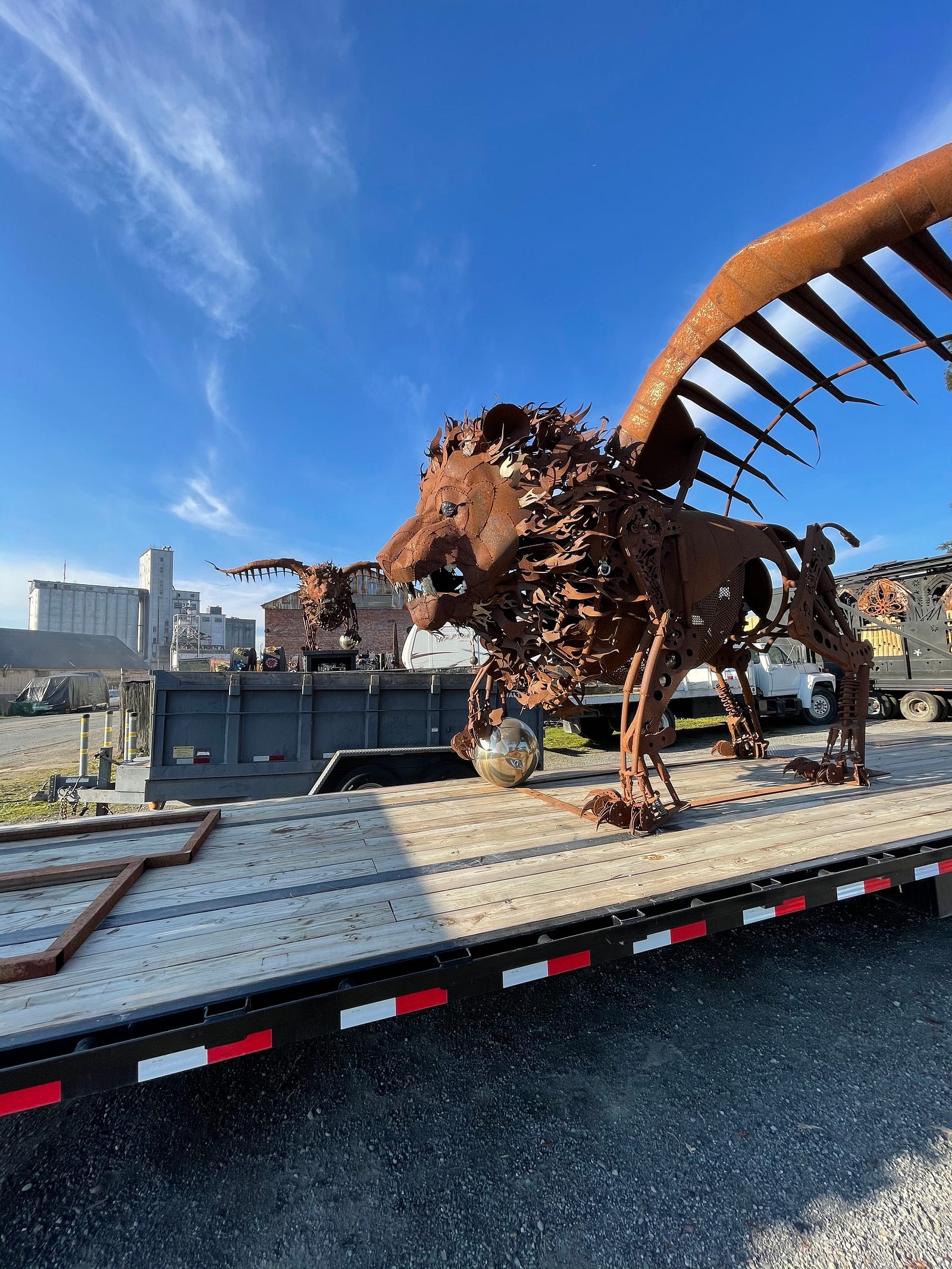
I live in Petaluma — a small city north of San Francisco. Many local artists create art for events like Burning Man or Coachella. When the art is not at the events, it is typically on full display on the artist’s yard.
I was walking past these winged lions and just thought about how cool they were. It wasn’t until later, when I was looking at the pictures, that I realized they were both standing on gazing balls.
I can’t help but wonder if this was intentional. If the artist knew about Jeff Koons’ theory on gazing balls, and intended to bring the observers into the piece and make them feel the courage and bravado of these lions.
Maybe a gazing ball is just a gazing ball.
But that’s the other aspect that makes art personal. Once it is released into the world, we can make it mean whatever we want it to, balls and all.

Responses